Altostratus AI: Building a Proactive AI Travel Disruption Service
Summary
My thesis was simple: within five years, every major travel management company will offer proactive AI traveler support.
The economics are overwhelming. AI can deliver faster, proactive traveler support at dramatically lower operating costs. The companies that adopt it first will gain an advantage with enterprise clients on both price and service quality.
Altostratus AI was my attempt to test that thesis before the industry caught up. I built a service that detected flight cancellations, texted travelers immediately, and offered to call the airline on their behalf. It validated traveler demand, but also revealed that the technology thesis was stronger than the distribution thesis. The product needed enterprise distribution through TMCs or airlines, and I chose to wind it down rather than pursue a capital-intensive path whose likely economics did not justify venture backing.
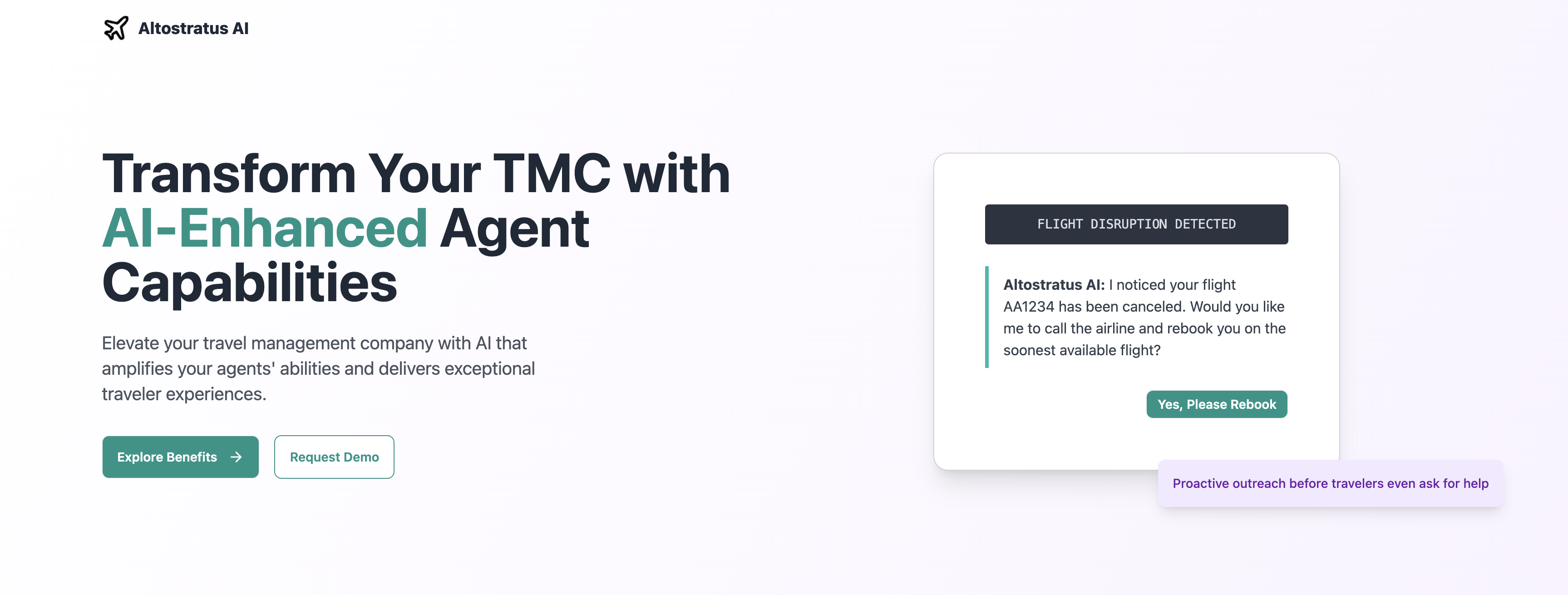
(Agent view demo, designed for desktop)
The Industry Thesis
The travel industry spent thirty years using software to automate booking. The next phase will be about automating operations. Booking was only the first half of the story.
Two things drive success for travel management companies: clients want to save money, and travelers want a better business travel experience. Most product requests ultimately serve one of those goals.
AI makes it possible to improve both at once. By automating service operations that previously required global support teams, TMCs can operate more efficiently while providing every traveler with faster, more proactive help. When one TMC can offer better service at a lower price, competitors that still depend on the old operating model will have to follow.
Software has made routine booking increasingly self-service. AI could bring a similar reduction in manual work to travel servicing, including monitoring disruptions, contacting suppliers, and coordinating changes. That creates opportunities both to help travelers directly and to give travel professionals more time for the judgment, relationships, and complex problems that require their expertise.
Predictions
When I began building Altostratus in 2024, I believed:
- Proactive AI support would become standard among major travel management companies.
- AI voice would become reliable enough to handle high-volume customer service, with humans available for exceptions.
- TMCs would compete on the strength of their digital products rather than the size of their operations teams.
- The most useful AI products would disappear into existing workflows instead of requiring customers to open another application.
- Human agents would increasingly supervise AI systems rather than perform every step themselves.
Altostratus was my attempt to test those predictions before they became obvious.
Testing the Thesis
The Product
Altostratus AI tracked upcoming flights. When a disruption occurred, it proactively texted the traveler and offered to help.
The pitch to the traveler was simple:
Sorry to see that your flight was canceled. Do you want me to call the airline and get you on the next available flight?
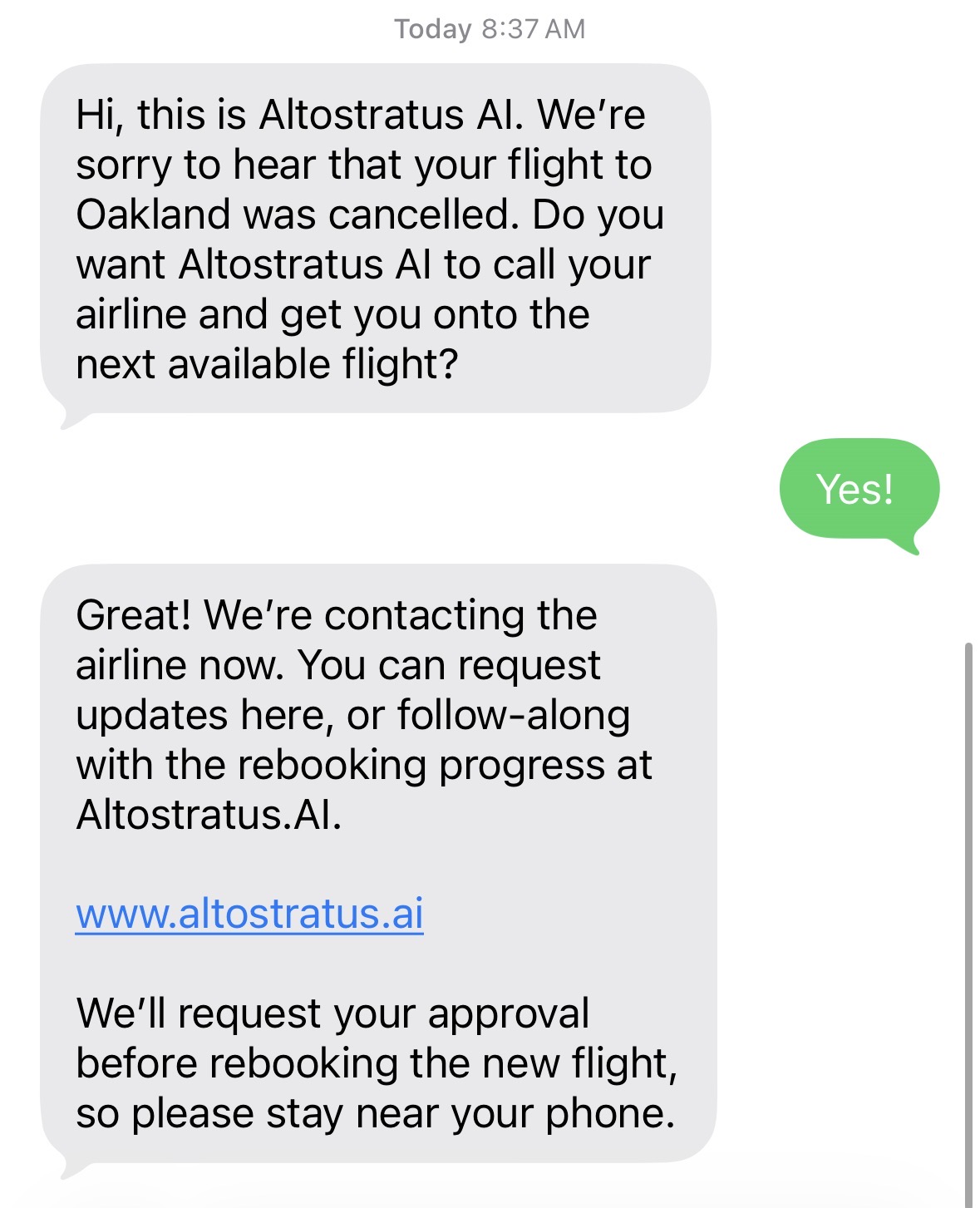
I don't believe AI products should be marketed primarily as AI. AI describes how a product works, not why someone buys it.
The customer-facing promise was not "talk to an AI agent." It was "I'll help get your trip back on track." AI changed the economics of delivering that service, but it was not the product. The product was relief at the exact moment a traveler needed it.
With the proactive customer service model, Altostratus could present the solution at the exact moment of pain. The airline sent a cancellation notification, and seconds later Altostratus texted and offered to help.
The product did not require the traveler to remember to open an app, search for a support number, or understand what to do next. It reached them when help was most valuable.
Airlines sometimes rebook canceled passengers onto a reasonable flight, but not always. They are obligated to get you to your destination, not necessarily to get you there quickly. My wife and I experienced this flying back from Japan. We landed in Seattle and saw the text: "Your flight to Portland at 12:30 PM has been canceled. Your new flight departs at 11:35 PM." There are flights from Seattle to Portland every hour. By standing in line and advocating for ourselves, we were able to get bumped to a 5 p.m. flight and make it home at a reasonable time. I wished Altostratus had existed to make that day easier.
What I Built
I built the MVP as a solo founder, covering the full product and technical stack:
- Web application and API built with Next.js
- Supabase backend for auth, database, and real-time state
- Twilio SMS for traveler communication
- Twilio Voice for outbound airline calls
- OpenAI Realtime Voice for AI phone conversations
- Flight tracking logic to monitor upcoming trips
- Internal context management to keep traveler, flight, and conversation state synchronized
- Multiple AI loops that determined when questions and answers needed to be relayed between the traveler and airline conversations, operating in real time with low enough latency for phone calls
- Human monitoring and takeover workflows
- Safeguards to reduce hallucination risk in a high-stakes customer service scenario
The hardest product challenge was not getting an AI model to talk. It was designing a reliable operating model around the AI: what it was allowed to do, what it was not allowed to do, how it should handle uncertainty, when it should escalate, and how a human could intervene if the model approached a risky edge case.
Before making a travel decision or when encountering unknown information, the voice AI talking to the airline would say, "Hold on, let me go ask the traveler about that." It would text the traveler with the question, wait for a response, and relay that response to the airline.
Trust mattered because the product operated in a high-stakes travel scenario. A hallucinated flight option, a missed rebooking option, or an unauthorized decision could materially harm a customer. Altostratus therefore needed to behave less like a chatbot and more like a human travel agent.
Product Principles
1. Solve the customer problem, not the AI demo
The customer-facing promise was not "talk to an AI agent." It was "I'll help get your trip back on track."
Everyone has experienced the pain of a flight cancellation. The promise was simple: I'll make it suck less. There was no need to wait on hold with the airline or stand in a long customer service line. Altostratus could deal with the airline while the traveler did something else.
2. Be proactive at the moment of pain
Most travel support is reactive. The traveler has to identify the problem, find the support channel, wait in line, and explain the situation.
Altostratus reversed that pattern. It detected the disruption and reached out first. This was also the trigger event for an API integration with an enterprise customer. Travel companies already track their travelers' flights. With very few code changes, they could integrate proactive rebooking assistance powered by Altostratus.
3. Keep the traveler in control
The traveler needed to know what Altostratus was doing and have confidence that the system would not make unwanted decisions on their behalf. The AI needed to recognize the limits of its knowledge and ask the traveler whenever something was unclear. The traveler could also text Altostratus at any point to request updates or changes.
4. Design for human takeover
The goal was not to pretend AI could resolve every edge case perfectly. The goal was to let AI handle repeatable work while allowing a human to monitor and take over when necessary.
If the AI failed, I would personally get on the phone with the airline to put the traveler's trip back on track. The handoff was seamless to the traveler, but it was essential for improving a system that offered to solve the problem. It had to work every time.
This became a minor logistical challenge as a solo founder: for months, I found myself tracking customers' flights at all hours of the day and night.
5. Delete the UI
The best interface for this product was no interface at all.
Most AI products add another application people have to remember to open. That is backwards for travel support. When a flight is canceled, nobody wants to log in, find the right screen, and explain the problem. They want someone to start fixing it.
The interaction begins when the traveler's flight is cancelled.
Altostratus tracked the flight, detected the disruption, and reached out by text. The consumer version still required travelers to add their flights in advance, but an enterprise integration would eliminate even that step. The travel company already knew the itinerary. Its systems could trigger Altostratus automatically, making the product invisible until the moment it became useful.
The Go-to-Market Plan
Historically, I have had success gaining support for original product ideas inside large organizations when there is a strong proof of concept. This is how I turned my side project of a hotel rate recommendation feature into BCD Travel's top development priority. A working prototype is more persuasive than an Excel model or PowerPoint deck.
With Altostratus, my plan was straightforward:
- Build a working travel disruption protection service powered by AI
- Sell it to the public as a proof of concept
- Share the working solution with travel management insiders who understood the problem but had not yet settled on a solution
A working product mattered because no one else could offer the "wow, this is the future" moment of proactive customer service solving a painful problem in the traveler's own life. Every company wanted to create the next great travel experience, and no one else was offering live, proactive service like this.
Validation
After six months of building, I launched the platform to real travelers in mid-2024.
By sharing it on a few forums and social media posts, I attracted about 50 signups, many from people with whom I had no personal connection. Altostratus tracked roughly 100-150 flights. This was enough usage to produce useful feedback while still being manageable for one person.
The pain point was easy to understand because almost every frequent traveler has experienced a cancellation, long hold time, or customer service line during a disruption. Airline customer service sometimes feels like talking to a robot. Now you could make them talk to your own robot.
Individual travelers understood the value quickly. The service was easy to explain: when your flight is canceled, you want someone to fix it while you do literally anything else. Even after I wound down the company, friends asked whether it was still running because their flights had been canceled and they wanted help.
No one cared if it was AI or not. They had a painful problem and wanted it to go away.
The Technology Was Right. The Distribution Was Wrong.
The consumer launch strengthened my confidence in the technology thesis. Altostratus worked as a proactive service, travelers understood the value immediately, and no one cared whether AI was involved. They wanted the problem solved.
But the launch also exposed the weakness in the distribution thesis. Based on industry cancellation rates, Altostratus needed to track roughly 60 flights to encounter one cancellation where it might be able to help and earn a small fee. A direct-to-consumer product was unlikely to become profitable without enormous scale.
The viable path was enterprise distribution through a TMC or airline that already had thousands of bookings. That would provide enough disruption volume to make the economics work, enough operational data to improve the AI, and the integration needed to make the product truly invisible to travelers.
The technology was moving in the direction I expected. The business required a distribution model, sales motion, and level of capital that did not fit the likely return.
As a one-person company, I did not fit the profile of a software vendor for a large enterprise. A large company expects procurement readiness, security reviews, implementation resources, account management, and forward-deployed engineers who can integrate the product into the client's systems.
Altostratus was designed for an easy API integration, but that was not enough. My pitch was less compelling than those of rival startups that appeared more stable because they had larger teams, more funding, and more enterprise implementation capacity.
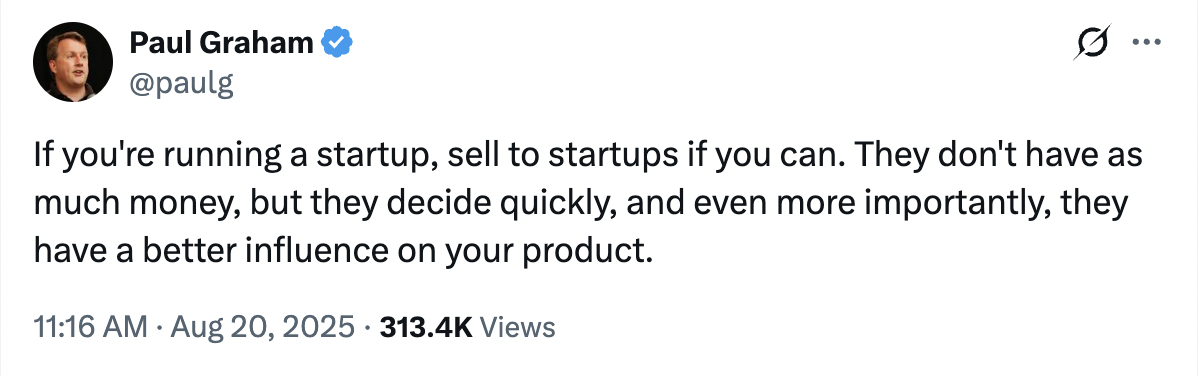
Excellent advice. I wish I had seen it earlier.
With competitors gaining more traction and the enterprise path requiring a level of capital and team size that I did not believe would lead to a good outcome for me as a founder, I wound down Altostratus at the end of 2025.
The Venture Capital Tradeoff
Altostratus had a strategic tension: the business likely needed enterprise sales resources to succeed, but I did not believe the likely outcome justified a large venture-backed path.
The product was valuable, but the acquisition ceiling seemed tied to how difficult it would be for a large travel company to build the same capability internally. As AI-powered software development improves, that build-versus-buy threshold moves lower every year.
A small acquisition could be life-changing for a solo founder who had raised very little money and retained most of the company. The same acquisition could be disappointing for a venture-backed company with multiple founders, a large team, and investors expecting large returns.
The math does not work for venture investors if the likely acquisition is modest. They do not want to invest $10 million in a startup that gets acquired for $12 million. I would have needed to argue that I was building a $200 million company, and I did not believe this product had that outcome.
What I Learned
Altostratus made me sharper as a product builder because I had to own the entire process: market thesis, customer pain, UX, technical architecture, AI behavior, safety, sales, support, and the decision to shut it down.
The biggest lessons:
- Startups should sell to startups.
- Enterprise trust is a product requirement. Enterprise buyers do not just evaluate the product; they also evaluate the vendor's integration risk, support model, procurement readiness, and operational continuity.
- Building an AI automation product is much like developing self-driving technology: the last 1% of automation takes 99% of the work. After the initial release, reducing human intervention becomes a core product metric.
What I Would Do Differently
If I approached this opportunity again, I would prioritize joining a team with the customer relationships, distribution, and resources to bring the product to market. Building Altostratus showed me how much I enjoy owning the product and technical work, and how much its success depends on pairing that work with a viable commercial model.
I applied that lesson to Canopy Commons, a network for small business owners to find new retail markets. The contrast was immediate. For that business, it did not matter that I was a one-person company. I could message small business owners directly, they would sign up, and I could get real customer feedback and usage without going through enterprise procurement.